Series: Engineering Judgment, Part 6
Publish date: 2026-07-23
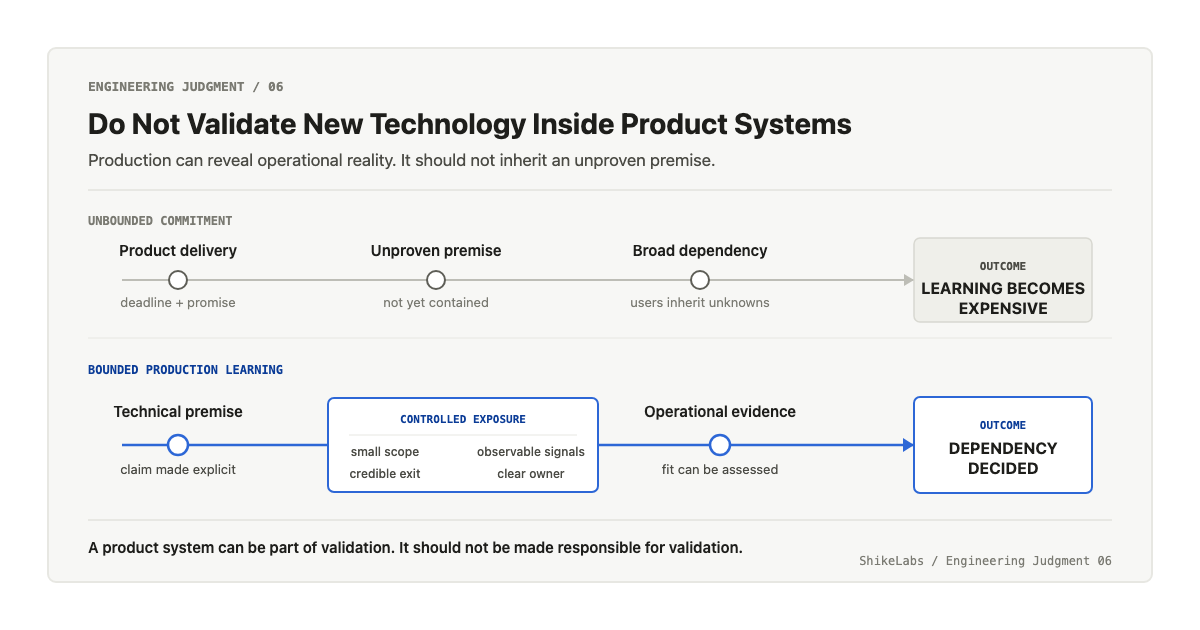
"We can use this product project to validate the new technology" is one of the most expensive sentences in engineering.
It usually arrives dressed as efficiency. There is already a product need. The team needs to build something real anyway. The new runtime, storage layer, model, framework, or execution path may eventually be useful. Building a separate experiment feels slow when a delivery path is already funded, staffed, and waiting.
The reasoning is not irrational. A real product does expose constraints that a toy environment cannot. It supplies real data shapes, real traffic patterns, real integrations, and the operational friction that makes an architecture either believable or cosmetic. Many technologies cannot be understood fully until they encounter a system that has users and consequences.
The mistake is not letting a new technology touch a product system.
The mistake is allowing a product delivery to become the primary test harness for a technical premise that the team has not yet learned how to contain.
That decision quietly joins two jobs that need different conditions in order to succeed. One job is to reduce uncertainty for users. The other is to discover uncertainty for the team. A product system is expected to make commitments: preserve data, behave predictably, recover from failure, and remain understandable to the people who will operate it after the original project has ended. A technical validation exists to find out whether an idea survives contact with reality at all. It must be allowed to fail, sometimes decisively.
When these jobs are joined too early, neither remains honest. The experiment cannot fail cleanly because a schedule now depends on it. The delivery cannot be planned cleanly because its technical foundation is still a question. What begins as an efficient use of one project becomes a system in which every unpleasant discovery is also a threat to a deadline, a customer promise, or somebody's judgment.
The Decision Contains More Than One Decision
Most teams do not say, "We are willing to place an unproven dependency in a production path." They say something smaller.
The current component is awkward. The new one has a cleaner model. The existing path may not scale forever. The product feature gives the team a reason to start. Perhaps a prototype already works, which makes the remaining risk feel like implementation detail rather than an open question.
But the decision contains at least three separate commitments.
The first is a claim of technical feasibility. Can this technology do the narrow thing we want? Can the model produce useful outputs under a known workload? Can the new storage engine meet the required semantics? Can a new execution path preserve correctness under the conditions we can simulate?
The second is a claim of operational fit. Can the technology be observed when it misbehaves? Can engineers diagnose it without reconstructing the original author's mental model? Does it fail in a way the surrounding system can absorb? Does it interact with deployment, security, persistence, capacity, and incident response in ways the team can actually operate?
The third is a commitment to dependence. Once the product path relies on the new mechanism, users, deadlines, and adjacent systems inherit its unfinished questions. The team is no longer deciding whether the technology is interesting. It is deciding who pays when the technology is wrong, incomplete, or merely harder to own than expected.
These commitments are related, but they are not the same. A successful prototype may establish the first. A controlled production exposure may be necessary to learn the second. Neither one, by itself, justifies the third.
Teams get into trouble when feasibility is treated as proof of fit, and fit is treated as permission to create broad dependency. The demo works, so the implementation is started. The implementation starts, so the feature has to ship. The feature is close enough that a rollback would look like failure rather than information. By the time the system reveals what the technology actually costs, the decision has become difficult to revisit for reasons that have little to do with engineering.
That is not validation. It is commitment arriving before evidence.
A Prototype Proves Less Than It Appears To Prove
Prototypes are useful because they make an abstract proposal concrete. They force interfaces to exist, expose missing assumptions, and often reveal that an idea which sounded inevitable in a meeting has no viable implementation. They should be treated as instruments for learning.
Their danger is that a convincing prototype can make the next set of questions invisible.
An experiment usually proves one path under conditions selected by the team. The data is small enough to inspect. The failure is local. The people who built it are available. The surrounding system has not yet accumulated compatibility rules, operational procedures, or user expectations around the new path. If it produces the wrong result, the team can stop, change an assumption, and try again.
A product system has a different shape. It receives inputs the team did not anticipate. Its data has history. Its performance is affected by neighbors. Its failure modes include partial deployment, stale state, degraded dependencies, unusual traffic, human error, and the old behavior that was never fully removed. An integration that is clean in a prototype may create an ambiguous ownership boundary in production. A new dependency that looks removable in code can become hard to remove once it has changed persisted data, user-visible behavior, or another team's operating assumptions.
"It works" is a weak conclusion. It may mean that the core mechanism is possible. It does not mean that the technology belongs on a path that needs reliable rollback, predictable recovery, or ordinary operational ownership.
The missing question is not whether the prototype is realistic enough. No prototype is fully realistic. The question is what has actually been learned, and what remains unknown after the demonstration succeeds.
If the unanswered questions are about throughput under normal load or compatibility with a known interface, the team may be close to a controlled production test. If they are about data integrity, failure recovery, security boundaries, or whether anyone outside the experiment's authors can operate the system, the product should not be asked to carry them silently.
Production Is Sometimes Where the Real Learning Starts
The absolute version of this principle is wrong. Some properties cannot be validated outside production.
Synthetic load rarely reproduces the timing, data skew, and dependency behavior of a living system. Staging environments age differently from production. They have different traffic, weaker histories, fewer integrations, and less organizational attention. A change can pass every reasonable pre-production check and still expose an interaction that exists only when real users, real caches, real retries, and real operations enter the picture.
That is not an argument for treating production casually. It is an argument for recognizing production as a distinct learning environment.
The useful form of production validation is not a leap from prototype to full dependency. It is a limited exposure designed to answer a specific operational question. The new path serves a bounded portion of traffic, a narrow class of work, or a reversible read-only function. The existing path remains available. The team knows which signals would show that the new behavior is unsafe or unhelpful. A person has the authority to stop the exposure before the discussion turns into a negotiation about whether the original plan can still be saved.
The distinction matters because production is not merely a larger test environment. It is where the system's obligations become real. Real users cannot be treated as an unpriced source of test data. Real data cannot be assumed to be reversible because a deployment can be reversed. In stateful systems, the code path may roll back while the writes, side effects, and downstream interpretations remain.
Production learning is necessary when the unknown is genuinely operational. It becomes irresponsible when the unknown is still whether the underlying technology can keep its basic promise.
That boundary is not always comfortable. It requires the team to name the question it is taking into production. "We need to see what happens" is not a question. "We need to learn whether this scheduler remains stable when one tenant creates sustained contention, while the current scheduler continues to process the rest of the workload" is a question. One can be bounded, observed, and stopped. The other is a hope with deployment access.
The Boundary Is the Experiment
When a team says it will validate a technology in production, the important design work is often not inside the technology. It is in the boundary around it.
The first boundary is the blast radius. A new mechanism should begin where its failure is small enough to understand. That may mean a small tenant cohort, a non-critical workflow, shadow evaluation, or a path where the existing behavior remains authoritative. The aim is not theoretical harmlessness. It is to make the consequences small enough that the organization can learn from them without immediately defending the decision that created them.
The second boundary is observation. A team should know what evidence would make the new path look healthy and what evidence would make it stop. That evidence is rarely a single latency graph. It may include incorrect outputs, recovery time, operator effort, unusual support load, resource contention, or the number of exceptions required to keep the new mechanism alive. If the only success criterion is that the feature remains on, the team will discover too late that adoption has replaced evaluation.
The third boundary is reversibility. This is deeper than a feature flag. A flag can stop future traffic while leaving state, data shape, and operational dependency behind. A credible exit path asks whether the old behavior can still serve the system, whether writes can be reconciled, whether the new path has created one-way migrations, and whether the surrounding teams can return to a known operating model without an emergency rewrite. Some changes cannot be perfectly reversed. When that is true, the team should make the irreversible part smaller and more deliberate, rather than pretending that rollback exists because the deployment tool has a button for it.
The final boundary is ownership. Novel systems are often operable while the people who made them are still close to the code. The relevant test is what happens when the incident occurs at an inconvenient hour, under incomplete information, with someone who did not design the experiment. If recovery depends on one engineer's memory, the technology has not yet become part of the product's capability. It is still a personal project with production permissions.
These boundaries are not process overhead added after the creative work is finished. They are the part that determines whether the organization is learning or merely exposing itself.
The Cost of Failure Changes With Its Location
The original attraction of combining validation and delivery is that it appears to remove duplicate work. There is one team, one implementation, one schedule, and one visible outcome.
What disappears is not duplicate work. It is the separation between different costs.
When an isolated experiment fails, the team loses time and perhaps some confidence in an idea. That is not trivial, but it is useful. The failure has a clear job: it tells the team that a premise was incomplete, that a constraint was underestimated, or that a different path is needed.
When the same discovery happens inside a product delivery path, it creates a different kind of debt. The roadmap has to move. Users may receive inconsistent behavior. Product logic becomes entangled with experimental logic. The new technology is kept alive by exceptions because removing it would now require undoing work in several places. Engineers begin working around the unstable path because the product cannot wait for a clean answer.
The system carries both the feature and the uncertainty that should have been resolved before the feature became necessary.
This is one of the ways technical debt becomes organizational debt. A poorly bounded experiment does not only leave code behind. It leaves a story: this is the thing we built for the launch; this is the thing a customer depends on; this is the thing nobody wants to question because too much effort has already gone into it. The cost of changing direction rises not because the evidence became less clear, but because the organization made the evidence expensive to admit.
There is a familiar pattern in projects that have gone this way. The technology is described as temporary for longer than anyone believes. The old path is kept alive because the new one is not yet trusted. Monitoring grows around the uncertainty instead of reducing it. A delivery date is met, but the system begins the next phase of its life with a boundary nobody can explain cleanly.
That outcome is not caused by novelty itself. It is caused by putting novelty in a place where the cost of learning has already become political.
Some Technologies Need Product Reality. They Still Need a Way Out.
There are cases where no clean laboratory exists. A new coordination model may only make sense under live contention. A storage path may only reveal its operational cost against a real history of data. An AI capability may be useful only when it meets the ambiguity of actual workflows. A protocol change may require behavior from a distributed network that cannot be reproduced faithfully in a closed environment.
In those cases, refusing all production exposure is not prudence. It is a way of preserving the current system's limits indefinitely.
But the absence of a perfect pre-production environment does not make a product deadline the correct experiment boundary. It makes boundary design more important.
The team may need a parallel path, a shadow workload, a narrow participant set, a manually reviewable action, or a version of the feature that can fail without making the rest of the product ambiguous. The exact mechanism changes with the system. The principle does not: users should not be forced to absorb an unanswered technical question simply because the organization did not reserve a place to ask it.
A technology that can only be introduced as a broad, irreversible replacement should be treated with unusual suspicion. It may still be necessary. Some migrations are inherently large. But then the decision should be made as a migration decision, with migration-level evidence, ownership, and risk acceptance. Calling it validation does not make the commitment smaller.
The language matters because it changes how a team prepares. An experiment is expected to produce an answer. A migration is expected to preserve continuity while changing a system beneath it. When the organization calls one the other, it tends to do the preparatory work for neither.
The Sequence Is Not About Being Slow
The disciplined sequence is often described as slower: build a prototype, validate it separately, build the product integration, introduce it gradually, then expand. That description is too mechanical.
Its purpose is to keep each stage responsible for a question it can answer.
Early work should expose whether the core technical premise is credible. It should be cheap enough to discard and serious enough to produce evidence rather than enthusiasm. The team should be trying to break the idea before a product schedule gives everyone a reason to protect it.
The next work should expose the operational boundary. This is where production-like conditions, and sometimes limited production exposure, become necessary. The team learns whether the technology can coexist with the system that already exists: its data, its tools, its operators, and its failure behavior. The result may be that the technology is sound but unsuitable for this system, at this time, under this ownership model. That is a successful validation outcome, even if the product does not adopt it.
Only then should broad product dependency become the question. By this point, the organization is not asking users to discover whether the mechanism is real. It is deciding whether the evidence is sufficient to make the mechanism part of what the product promises.
This sequence is faster in the only sense that matters: it prevents a product delivery from becoming a research program after the product has already committed to a result.
Where Uncertainty Belongs
Engineering does not become responsible by eliminating uncertainty. That would make meaningful change impossible. The responsibility is to put uncertainty where the system can learn from it without confusing learning with harm.
Some systems need conservative cores. Authentication, persistence, billing, recovery, and control planes carry obligations that make novelty expensive. A new technology in those areas may still be justified, but it needs a stronger case and a more deliberate path into production than a reversible improvement at the edge.
Other parts of a system may define its future ceiling. If the existing runtime cannot meet a necessary workload, if a coordination model has become the limiting factor, or if a new capability is essential to the product's next stage, then avoiding uncertainty can become its own form of irresponsibility. The answer is not to pretend that the new path is mature. It is to give the organization a way to learn about it without making the whole product carry the first failure.
Do not validate new technology inside product systems is therefore not a prohibition on production learning. It is a refusal to let a delivery path answer questions that the team should have asked before the delivery became necessary.
A product system can be part of validation. It should not be made responsible for validation.
Member discussion: