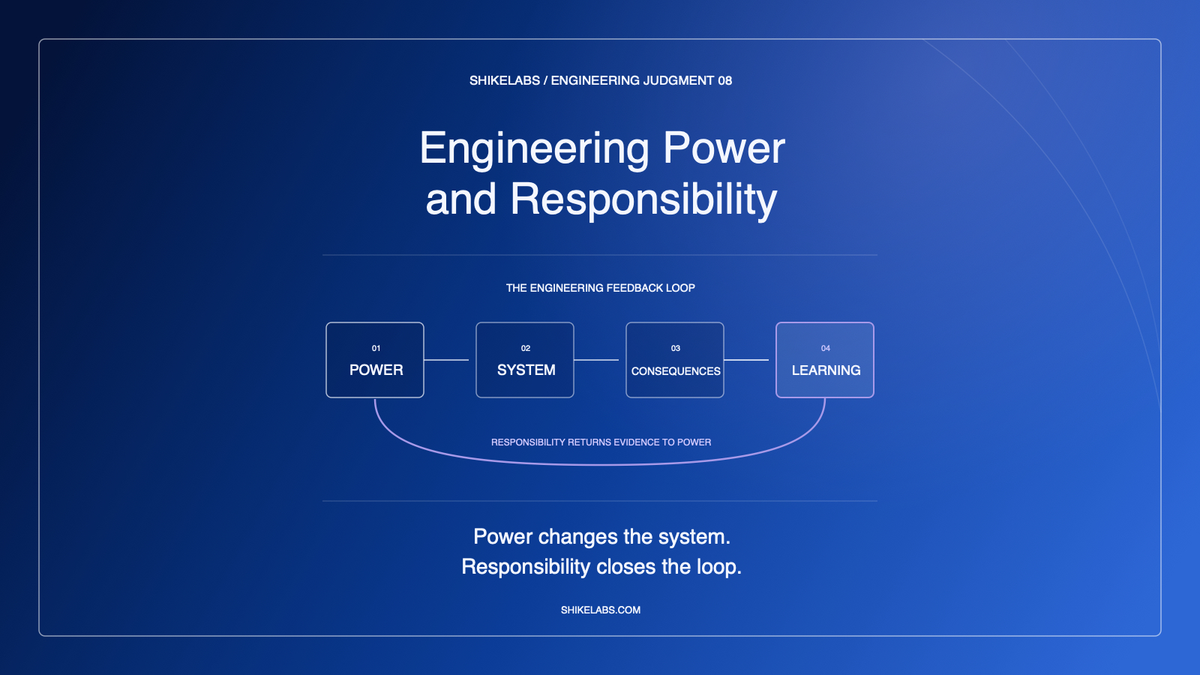
Series: Engineering Judgment, Part 8
Engineering decisions change character when they enter an organization.
On a whiteboard, an architecture can be evaluated through constraints, tradeoffs, and failure modes. Inside a real company, the same architecture is also shaped by who can approve it, who can delay it, whose warning can stop it, who has to operate it, and whether the people making the decision will still be present when its delayed costs become visible.
This does not make engineering less technical. It means the organization is part of the technical system.
A migration can have a correct design and still be launched under conditions that make it unsafe. A platform can be appropriate in principle and still fail because the team required to adopt it had no influence over its boundaries. A recovery mechanism can look complete in review while the operators who understand the real failure modes have only advisory authority.
In each case, the technical artifact tells only part of the story. The rest is a question of engineering power and responsibility: who can change the direction of the system, who remains connected to the consequences, and whether those consequences can change the next decision.
The central problem is often described as accountability. That word easily becomes confused with blame. Blame looks backward and asks who should absorb the cost of a bad outcome. Engineering responsibility should do something more useful. It should close the feedback loop between a decision and what the organization learns from it.
Organizations Are Part of the System
Power in engineering is not limited to title or formal approval. It is the practical ability to alter the trajectory of a system.
An engineer has power when they can change scope after discovering an invariant. An operator has power when evidence from production can stop a rollout. A technical lead has power when they can choose a reversible path instead of a faster irreversible one. A platform team has power when it can define the contracts other teams must follow. A committee has power when its recommendation is treated as a requirement, even if its charter says that it only advises.
Power therefore exists wherever a technical direction can be made easier, harder, mandatory, or impossible.
Responsibility is the other half of that mechanism. It is the continuing obligation to observe what a decision produces, repair the system when its assumptions fail, and carry what was learned into future choices. This obligation needs time. Many engineering decisions appear successful at launch and reveal their real cost only through maintenance, incidents, migration friction, or constraints on later work.
When power and responsibility remain connected, an organization can learn. The decision maker encounters evidence that was not available during planning. The model of the system becomes less abstract. Assumptions are corrected. The next decision is made with better information.
When they separate, the organization may still ship, but its learning mechanism weakens. Decisions continue to enter the system while consequences accumulate somewhere else.
Responsibility Is a Feedback Loop
A consequential engineering decision can be represented as a loop:
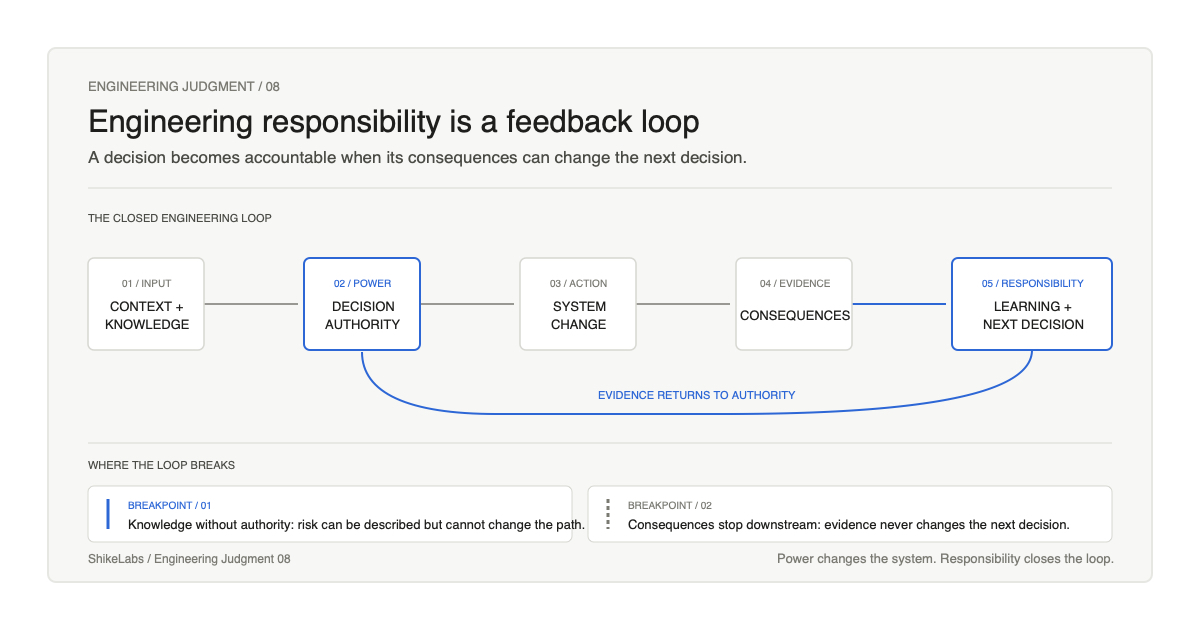
context → decision authority → system change → consequences → learning → next decision
Context includes the problem, constraints, operational history, system boundaries, and the knowledge held by people close to the work. Decision authority turns some interpretation of that context into a commitment. The commitment changes the system. The changed system produces consequences, including outcomes that were expected, delayed, or never considered. Those consequences become learning only when they return to people and mechanisms capable of changing the next decision.
The loop is what makes responsibility productive.
A named owner who can be blamed after an incident does not necessarily create this loop. If that person could not alter the decision, did not receive the relevant information, or loses authority as soon as the project launches, the name provides administrative clarity without engineering control. Equally, a powerful decision maker who receives a status report but never participates in maintenance may be informed about the consequences without truly being exposed to them.
Exposure matters because consequences contain information that plans cannot. A service owner learns which operational states are difficult to distinguish. A team maintaining a shared framework learns which abstractions create dependency rather than leverage. Engineers completing a long migration learn which compatibility assumptions were false. These are not merely costs to allocate. They are evidence about the quality of the original decision.
Responsibility closes the loop when that evidence has a credible path back to authority.
Three Ways the Loop Breaks
The first break is responsibility without power.
This is common among engineers and operators closest to production. They are expected to preserve reliability, meet the deadline, and repair failures, but they cannot change the scope, reject the architecture, or delay the rollout. Their knowledge enters the decision as advice rather than as a constraint.
Consider a data migration that must run while old and new application versions coexist. The engineers implementing it know that rollback requires preserving an ordering guarantee across both versions. Leadership has already committed to a date, and the project structure allows the engineers to recommend additional time but not to change the launch condition. If the migration fails, those same engineers will restore the data and explain the incident.
The problem is larger than an unfair distribution of stress. The organization has placed the most relevant knowledge outside the effective decision boundary. Over time, people adapt. Risks become “follow-up work.” Objections become softer because strong objections do not change outcomes. Reviews continue to record warnings, yet the warnings no longer function as control signals.
The second break is authority without exposure to consequences.
A central architecture group may select a platform for consistency across many teams. The decision can be thoughtful and well documented. If the group does not operate the platform, perform the migrations, or lose delivery capacity when the abstraction leaks, however, important costs remain external to its evaluation.
Distance from consequences changes what looks optimal. Standardization is visible at the decision layer; integration exceptions are distributed across teams. Architectural elegance is visible in diagrams; recovery complexity appears during incidents. The launch milestone is immediate; the maintenance burden arrives over years. None of this requires careless people. The structure itself filters which evidence reaches the people with authority.
The third break is collective participation without persistent ownership.
Many organizations respond to risk by adding reviewers. Product, engineering, security, architecture, operations, and leadership all participate. The decision becomes broadly discussed and weakly owned. Every participant contributes a perspective, but no one remains attached to the complete tradeoff after approval.
When the outcome is poor, each group can accurately describe the boundary of its involvement. Architecture advised. Security approved the threat model it received. Product set the requirement. Engineering implemented the agreed design. Operations inherited the service. The process has signatures, minutes, and tickets, yet no complete feedback path.
Participation can improve a decision. It cannot replace clear decision rights and durable consequence ownership.
Consequence Distance
The three failures share a variable that deserves more attention: consequence distance.
Consequence distance is the organizational distance between making a decision and living with what the decision causes. It can be created by hierarchy, time, team boundaries, contracting arrangements, project handoffs, or metrics that end at launch. The distance is small when decision makers remain close to operation and can update the system. It grows when one group chooses, another implements, a third operates, and no mechanism returns the resulting evidence with enough force to alter future choices.
Some distance is unavoidable. Senior leaders must make decisions whose effects extend beyond their direct experience. Architecture groups exist because local teams cannot see every system-wide constraint. Security and compliance decisions deliberately introduce authority outside a product team. The goal is not to make every decision local.
The goal is to design a return path for consequences.
For a cross-system platform decision, that may mean measuring migration effort and operational exceptions rather than only adoption. For a reliability tradeoff, it may mean giving production evidence explicit authority to pause delivery. For an irreversible data change, it may mean keeping the decision owner attached through the compatibility period rather than transferring ownership at launch.
The larger the consequence distance, the more deliberate the return path has to be.
AI Increases Decision Velocity
AI makes this organizational problem more visible because it increases the speed and apparent completeness of technical proposals.
A manager can request a migration plan and receive a detailed sequence with rollback steps. An architecture group can compare several platform designs before a meeting. A team can move from requirement to implementation, tests, and documentation with less friction. This is useful capacity, and it can improve decisions when people use the additional options to expose assumptions and gather evidence.
It can also increase decision velocity without reducing consequence distance.
Generated artifacts often arrive in the language of finished engineering: structured plans, explicit tradeoffs, clean interfaces, and confident explanations. That form can give decision makers more practical power because a proposed direction becomes easier to approve and execute. The people who will maintain the result may still hold context that was absent from the generation process, and they may still lack the authority to reject the path.
The failure is not that AI participated. The failure is that an acceleration in proposal and implementation capacity is mistaken for an acceleration in organizational understanding. More complete artifacts can move through an already broken feedback structure faster.
This connects engineering responsibility to causal ownership. An AI-assisted decision still needs people who can explain the problem boundary, identify what evidence would invalidate the approach, observe the production outcome, and change direction when the assumptions fail. If those responsibilities are distributed across groups without a return path, generated rigor becomes another layer of administrative confidence.
AI changes the speed of the loop. It does not close the loop for us.
Designing Authority for Learning
Healthy engineering governance should optimize for learning as well as control. That begins by placing decision authority close enough to relevant knowledge and consequences.
Local, reversible decisions can usually remain with the team that understands and operates the system. Decisions deserve broader governance when they are difficult to reverse, cross ownership boundaries, create systemic risk, or impose costs on teams that are not represented. Escalation should correspond to consequence scope, rather than serving as a general substitute for trust.
The people carrying long-term operational responsibility also need more than an opportunity to comment. Their evidence must be able to change launch conditions, narrow scope, or force a reversible path when the failure model is incomplete. This does not require an unlimited veto over every decision. It requires explicit authority where their knowledge is part of the correctness boundary.
Decision records can help if they preserve the feedback model rather than only the approval. A useful record states what the organization believed, which tradeoff it accepted, what outcome it expected, which signal would show that an assumption was wrong, and who can act when that signal appears. Six months later, the record should help a maintainer decide whether the original reasoning still holds, not merely prove that the process was followed.
Responsibility must also last long enough for delayed evidence to arrive. Teams should not be permanently trapped by every system they create, but organizations need continuity across launch, stabilization, and the period in which long-term costs become legible. A clean handoff transfers context, authority, and an escalation path. Throwing a repository over a boundary transfers only artifacts.
These mechanisms do not eliminate disagreement or failure. They make disagreement consequential and failure informative. That is what a functioning feedback system is supposed to do.
Where Engineering Judgment Becomes Real
Engineering judgment is often discussed as an individual quality: the ability to see tradeoffs, resist unnecessary complexity, choose the right problem, preserve iteration speed, and distinguish novelty from value. Those capabilities matter. They are insufficient when the organization cannot convert judgment into action.
An engineer may correctly identify a risk and still be structurally unable to change the decision. A leader may make a reasonable tradeoff and never receive the evidence that would refine it. A review process may gather excellent perspectives while dissolving responsibility across everyone who attended.
The systems we build reflect these arrangements. Authority determines which judgment can change the path. Responsibility determines whether the consequences improve the next judgment.
That is why power and responsibility have to meet inside the same feedback loop. The point is not to find a person to blame when the system fails. It is to keep the organization capable of learning from what it builds.
Power changes the system. Responsibility closes the loop.
Member discussion: