Series: Engineering Judgment, Part 5
Publish date: 2026-07-17
Web: https://shikelabs.com/articles/innovation-is-a-value-judgment
Innovation is one of the few words in engineering that arrives with its conclusion already attached. Once a proposal is described as innovative, opposing it can sound like a defense of the past. The new architecture appears more ambitious, the new technology more advanced, and the harder implementation more worthy of a strong team.
That framing is attractive because it turns a difficult decision into a technical ranking. If one path is newer, cleaner, or more sophisticated, it seems to represent progress. Yet engineering systems do not benefit from sophistication in the abstract. They benefit when a decision creates enough real value to justify the uncertainty and complexity required to make it work.
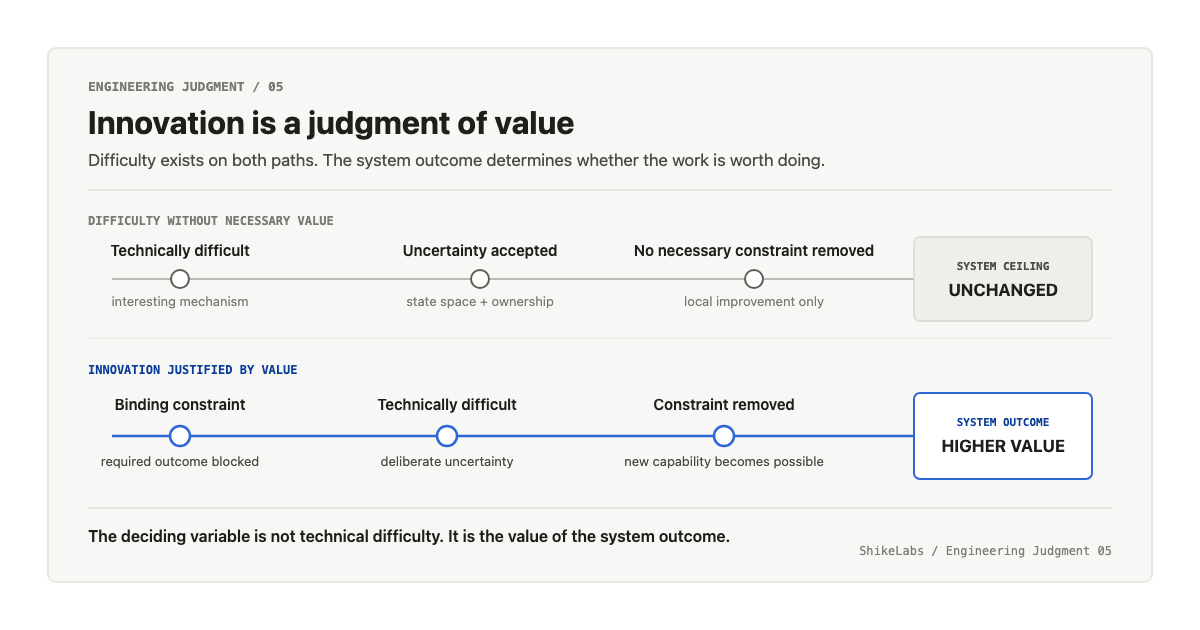
This is the distinction I want to make: innovation is a judgment of value, not a pursuit of difficulty.
Difficulty tells us something about the work. It tells us almost nothing about whether the work deserves to be done.
Why Difficulty Feels Important
Engineers are naturally drawn to hard problems. Serious engineering would be impossible without that appetite. Difficult work creates intellectual energy, reveals the limits of our tools, and gives capable people a reason to stretch beyond familiar solutions.
The danger begins when difficulty becomes a proxy for importance.
A challenging problem can generate more excitement than an ordinary constraint with larger consequences. In design reviews, we may spend hours on the sophisticated path because it gives us more to discuss, while the value of the outcome receives only a few sentences.
This bias is reinforced by the way engineering work is recognized. A new runtime, scheduler, storage engine, or abstraction can be demonstrated and explained. Restraint is harder to display. Keeping a stable path or deciding that a difficult mechanism is unnecessary rarely looks like an achievement, even when it prevents years of avoidable cost.
None of this makes difficult work unimportant. It means difficulty must be separated from value during the decision. The first describes the technical challenge. The second describes what changes for the system, its users, and the organization responsible for operating it.
When those two ideas are allowed to merge, teams begin to pursue hard problems because solving them feels like progress. The system then absorbs the cost of an ambition that was never required by its actual constraints.
The Same Technical Path Can Be Wasteful or Necessary
Consider a team building an execution system. The current design processes work sequentially. It is simple to reason about, easy to observe, and relatively predictable during failure. Someone proposes parallel execution.
The proposal is technically credible. Parallel execution could increase throughput and reduce latency under the right workload. It is also a serious engineering challenge. The system may need conflict detection, scheduling policy, deterministic ordering, state-isolation rules, new observability, and recovery logic for partial execution. Testing must cover interactions that did not exist in the sequential model.
Suppose the current system is nowhere near its throughput limit. User-visible latency is dominated by network calls or storage. The workload contains little independent work, and the next stage of the product does not require materially higher execution capacity.
Under these conditions, parallel execution may still be interesting. It may even produce a successful benchmark. What it does not produce is enough system value to justify its cost. The team would be purchasing new state space, new failure modes, and permanent maintenance obligations while leaving the real system ceiling almost unchanged.
Now change one condition. Assume sequential execution has become the binding constraint. Required workloads cannot complete within the latency budget. Hardware scaling has reached an economic limit. The product's next core capability depends on processing independent operations concurrently, and no simpler optimization can close the gap.
The technical work has not become easier. Its value has changed.
Parallel execution can now be a justified innovation because it removes a necessary constraint. The uncertainty is being accepted for a specific outcome that the existing path cannot provide. The team still has to contain the new complexity, prove correctness, design recovery, and own the mechanism after launch. But it can explain why those costs deserve to exist.
This is why technologies cannot be classified as innovative in isolation. The same design can be premature in one system and essential in another. The difference is not the sophistication of the mechanism. It is the value created by changing the system's boundary.
Innovation Is an Exchange
Every meaningful technical innovation is an exchange.
The system gains something it could not obtain through the current path: a higher performance ceiling, a new capability, a safer operating model, a lower unit cost, or a form of control that was previously impossible. In return, the organization accepts uncertainty. It may also accept migration risk, unfamiliar failure modes, more demanding operations, and a long-term ownership obligation.
Engineering judgment is the act of deciding whether that exchange is worth making.
Discussions about innovation often account for only the upside. A proposal is evaluated by the capability it promises, while the cost is treated as an implementation detail. In reality, the cost becomes part of the system. It lives in deployment procedures, debugging time, incident response, compatibility rules, and the attention required to keep the new path healthy.
The cost also survives the original advocates. Once a technology becomes part of a product system, someone must understand it during an incident, decide how it evolves, and remove it if the value never arrives.
A valuable outcome can justify all of that. A merely impressive outcome cannot.
The useful question is therefore not whether the team can build the advanced path. Capable teams can make many difficult ideas work. The useful question is whether the resulting change in the system is important enough to deserve the uncertainty, complexity, and ownership the path creates.
Value Is a System Property
Technical proposals are often compared through local metrics: benchmark performance, implementation elegance, theoretical scalability, code reuse, or conceptual consistency. These measurements are useful, but they do not determine value by themselves.
Value appears at the system level.
A faster component has limited value if it does not improve end-to-end performance. A general abstraction has limited value if it slows the main workflow and serves only hypothetical use cases. A cleaner architecture can be a poor trade if it requires a risky migration while the existing design is stable and sufficient. A technically superior database may create negative value if the team cannot operate or recover it reliably.
The evaluation must cross the boundary of the proposed technology. What outcome becomes possible? Who benefits? Which constraint disappears? Does the improvement change the system's trajectory, or only the internal appearance of one part?
Innovation also cannot be reduced to financial return or immediate delivery. Some value is structural. Better correctness guarantees, reduced operational risk, or a simpler recovery model may be decisive for a system that has reached the limit of its current safety model.
The standard is not short-term usefulness. It is consequential value.
If the existing path can continue to meet the system's real requirements at an acceptable cost, replacing it needs a strong argument. If the existing path has reached a boundary that blocks a necessary outcome, refusing to change may become the more expensive and less responsible decision.
Both restraint and ambition can be correct. The system's condition decides which one has value.
AI Makes Experimentation Cheaper, Not Judgment Optional
AI has lowered the cost of exploring technical possibilities. Engineers can learn unfamiliar libraries faster, generate prototypes, compare implementations, and build convincing demonstrations in days rather than weeks. This is a genuine expansion of engineering capacity.
It also makes weak innovation decisions easier to disguise.
Producing working code quickly can show that an idea is possible, but it says little about whether the mechanism belongs in a maintained system. A demonstration does not reveal the full operational model, difficult production states, migration burden, or cost of keeping the technology understandable.
The cheaper the experiment becomes, the more experiments a team can create. Without a clear value test, successful prototypes accumulate into proposals, proposals accumulate into dependencies, and dependencies accumulate into a system that has accepted more novelty than it can operate.
AI reduces the cost of asking, "Can we make this work?"
It does not reduce the importance of asking, "What becomes valuable if it works?"
Nor does it remove the cost of being wrong. A discarded experiment may be cheap. A wrong technical path embedded in authentication, persistence, execution, billing, or recovery is not. Once users and other systems depend on it, the decision must be maintained, migrated, or unwound.
Faster exploration should make teams more selective about production adoption because they can compare more paths before committing. It should not turn every feasible idea into an architectural candidate.
Where Uncertainty Belongs
Engineering requires stability because real systems carry obligations. Users expect continuity. Data must remain correct. Operators need predictable recovery. Teams need enough shared understanding to make changes without fear.
Engineering also requires evolution. A system that never accepts uncertainty will eventually preserve its current limitations more carefully than it serves its purpose.
The mature position is to place uncertainty where the value depends on it.
Some parts of a system should remain deliberately conventional. Authentication, persistence, audit paths, deployment, and recovery often reward mechanisms the team understands deeply. Novelty in these areas needs an unusually strong case because mistakes damage trust and are expensive to reverse.
Other parts may define the system's future ceiling. A runtime may need a new execution model. A protocol may need a different coordination mechanism. An AI product may need a capability that existing models or interfaces cannot provide. When the constraint is real and the outcome matters, refusing uncertainty becomes a way of refusing the next stage of the system.
The goal is not to minimize uncertainty everywhere. It is to spend uncertainty deliberately.
That requires boundaries. New mechanisms should be isolated enough to test, observe, replace, and roll back where possible. Adoption should expose evidence before it creates broad dependency. Ownership should be clear before the system needs emergency judgment. The team should know what result would validate the decision and what result would cause it to stop.
Innovation becomes more responsible when its uncertainty is bounded and its value can be observed.
A Value Test for Technical Innovation
Before committing a new technical path to a product system, I find it useful to make both sides of the exchange explicit.
- What necessary outcome is blocked today? Name the constraint in system terms, not as dissatisfaction with the current technology.
- Does the new path materially change that outcome? A local improvement is insufficient if the system ceiling remains the same.
- What uncertainty are we accepting? Include operations, failure recovery, migration, team knowledge, and long-term maintenance.
- Can the uncertainty be contained? Prefer staged adoption, observable boundaries, and a credible fallback over an irreversible system-wide commitment.
- Who will own the path after launch? Innovation without durable ownership transfers excitement into maintenance debt.
- What evidence would make us stop? A decision is easier to correct when failure criteria exist before sunk cost and identity attach to it.
These questions are not a process for suppressing ambitious work. They protect ambitious work from weak justification. When the value is real, the argument becomes clearer. The team can explain why the risk is necessary, where the complexity will live, and what higher capability the system is buying.
When those answers remain vague, difficulty should not be allowed to fill the gap.
The Judgment
True innovation does not begin with a desire to use a new technology or prove that a difficult design can be built. It begins when the current system has reached a boundary that matters.
From there, the decision is an evaluation of value. Is the blocked outcome necessary? Is the new path capable of reaching it? Is that gain large enough to justify the uncertainty the system and organization will have to carry?
Sometimes the responsible answer is to keep the existing path. The system does not need every available improvement, and technical restraint prevents unnecessary complexity from becoming permanent.
Sometimes the responsible answer is to take on the hard problem. A real ceiling has been reached, simpler options are exhausted, and the next capability cannot exist without a new approach.
The difficulty may be identical in both cases. The value is not.
Innovation is a judgment of value, not a pursuit of difficulty.
Engineering restraint protects the system's floor. Engineering judgment decides which ceilings are worth breaking.
Member discussion: