Series: Engineering Judgment, Part 3
Many engineering teams can build the first version of a system. Fewer teams can keep changing it safely after reality starts disagreeing with the design.
That difference is the real meaning of iteration.
Iteration is not a calendar ritual. It is not a sprint label, a weekly release meeting, or a faster deployment train. Those are only surface forms. Real iteration is the system's ability to be modified, verified, and moved forward without losing control.
When that ability is missing, a project may still ship. It may even look complete. But over time it loses the capacity to evolve.
Two Meanings of the Same Word
In some software teams, iteration means continuous correction: build a small version, expose it to reality, observe what breaks, then adjust the system while the cost of being wrong is still manageable.
In other environments, iteration means the next major version. Requirements freeze, design review happens, implementation begins, and change is treated as a disruption. After the release, a new cycle starts.
Both groups use the same word, but they are describing different engineering worlds.
The difference is not a matter of personality or culture. It is a difference in how the team handles uncertainty. One model assumes that enough planning can make the future mostly knowable. The other assumes that important facts only appear after the system runs.
For simple systems with stable boundaries, the first model can work. For complex systems, it usually breaks down because the most important constraints are not visible at the beginning.
Uncertainty Cannot Be Designed Away
Complex systems contain unknowns that cannot be eliminated in advance. Interfaces behave differently under real load. Users follow paths nobody expected. Integrations fail in partial ways. Data has shapes that test fixtures did not include. Operational constraints appear only after deployment.
This does not make design useless. Good design reduces the search space and prevents entire classes of mistakes. It gives the team a starting structure, a vocabulary, and a set of boundaries for reasoning about the work.
But design cannot replace feedback.
If a team believes it can think through every important behavior before implementation, it will overinvest in upfront completeness and underinvest in correction mechanisms. The result is a system that looks coherent before it meets reality and becomes rigid afterward.
The more practical question is not whether the first design is right. It is whether the system can recover when the first design is wrong.
The Cost of Change Is the Divider
Some systems improve over time. Others become harder to touch.
The divider is not whether they have bugs. Every meaningful system has bugs. The divider is the cost of change.
If changes are local, observable, testable, and reversible, the system can learn. Engineers are willing to adjust it because the blast radius is bounded. A wrong assumption becomes a correction, not a political event.
If every change triggers cross-team coordination, long regression cycles, uncertain production risk, and a recovery plan nobody trusts, caution becomes rational. Nobody wants to be the person who breaks the system, so the organization slowly develops a habit of avoidance:
- do not touch that module
- route around that behavior
- document the exception
- accept the limitation
- wait for the rewrite that never comes
This is how systems become finished and frozen at the same time. They keep running, but the team no longer believes they can be safely changed.
Iteration Solves for Uncertainty, Not Speed
People often talk about iteration as a way to go faster. That is incomplete.
The deeper value of iteration is that it gives the team a mechanism for handling uncertainty. You do not need to know everything upfront if you can safely learn. You can start with an approximate solution, validate it in the real environment, and correct it before the wrong assumptions become permanent.
Speed matters because it reduces the cost of being wrong. A mistake discovered after one day is usually a design input. The same mistake discovered after three months becomes a negotiation, a migration, or a sunk-cost argument.
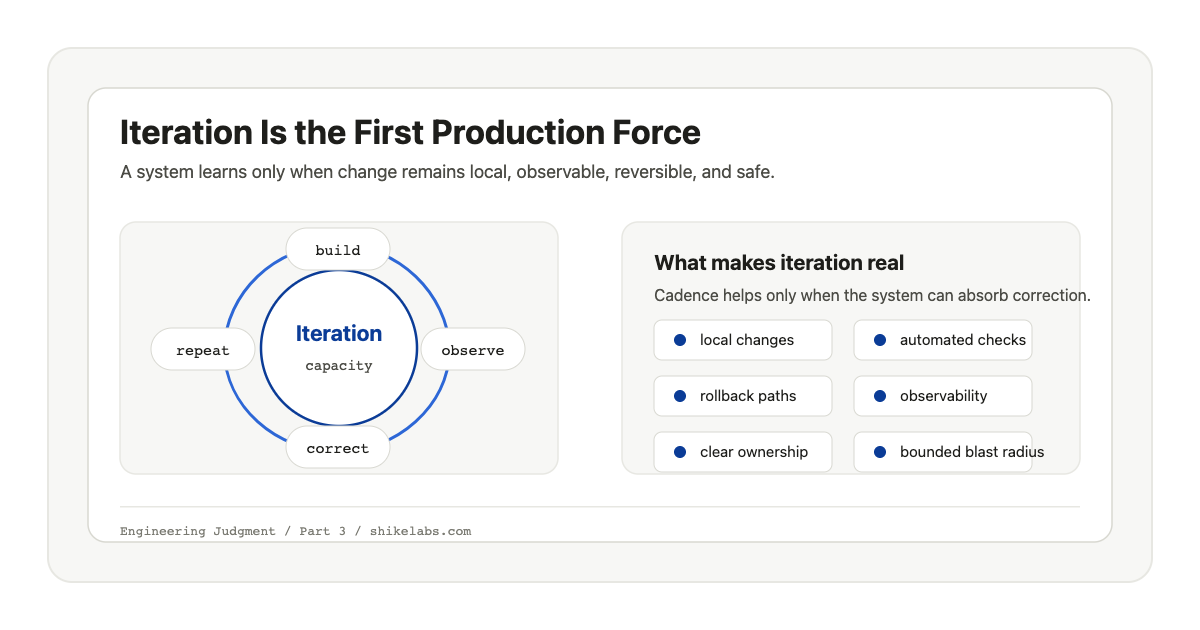
But motion is not the same as iteration. Fast movement without verification is just faster confusion. Real iteration requires the whole loop:
- build
- observe
- correct
- repeat
If one part of that loop is missing, the team is not iterating. It is only moving.
Cadence Is Not Capability
Some organizations try to copy iteration by copying the rhythm. They move to weekly releases, create sprint ceremonies, and ask teams to ship more frequently. Then everything becomes worse.
This happens because cadence is not the foundation. Capability is.
A system can support frequent iteration only when it has the engineering structure underneath it:
- modular boundaries that keep changes local
- automated checks that catch basic regressions
- deployment paths that do not require heroic coordination
- rollback mechanisms that reduce fear
- observability that shows what changed after release
- ownership clear enough for fast decisions
Without those foundations, higher release frequency increases chaos. The organization concludes that iteration is reckless, when the real problem is that the system was never built to sustain it.
Iteration is not a management demand. It is an engineering capability.
Quality Is Iterated Into Existence
There is a quiet truth in engineering: system quality is rarely designed perfectly at the beginning. It is produced through correction.
The first version can establish direction, create boundaries, and avoid obvious traps. But the final shape of a good system comes from repeated contact with real constraints. The system becomes better because the team can keep making it better.
This is why many durable systems have awkward histories. They were not born elegant. They became useful because their teams could keep changing them without losing control.
It is also why some highly designed systems fail. They depend on being right too early. Once reality pushes back, the cost of correction is too high, so the system protects its original assumptions instead of learning from their failure.
The Practical Standard
When evaluating a technical path, ask how it affects iteration:
- Does it let us ship in smaller steps?
- Does it let us discover errors earlier?
- Does it keep changes local?
- Does it preserve rollback?
- Does it make debugging easier or harder?
- Does it lower the cost of the next correction?
These questions matter more than whether the architecture looks complete. A complete architecture that cannot be corrected is fragile. An incomplete system that can safely learn may become excellent.
This standard also changes how we evaluate engineering decisions. The best decision is not always the most elegant one, or the one that anticipates the largest future. Often, it is the decision that preserves the team's ability to make the next correction.
The First Production Force
Iteration is the first production force because it converts uncertainty into progress.
Without iteration, the team has to be right from the beginning. In complex systems, that is too much to ask. The more serious goal is to build a system that can be wrong, learn, and continue.
That is the difference between a project that merely ships and a system that keeps becoming better after it ships.
Member discussion: